Machine Learning for Cell Migration

Integrated platform for evaluating the migratory phenotype of tumor cells based on microfluidic devices and machine learning algorithms which, on the long run, would become an instrument used under clinical settings to predict the metastatic potential of any given tumor, based on direct phenotypic data.
Cell Flow Logo

Methodology

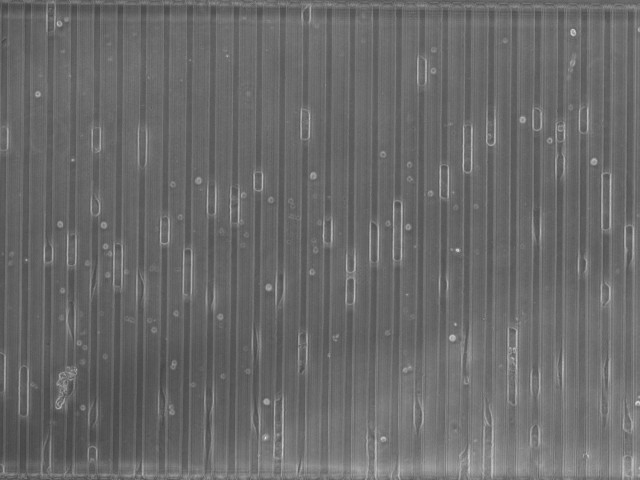
Microfluidics devices were designed and produced in order to evaluate mesenchymal and amoeboidal cell migration. Time-lapse imaging of migrating cancer cells in 10μm and 50μm microfluidic devices was used to characterize cells migration in multiple experiments. Image sample of cells migrating through microfluidics channels can be observed next. The evaluation process for speed, persistence, percentage of migratory cells and mitochondria position in single cells and clusters migrating in microfluidic devices was automatized using machine learning approach and image processing techniques. Cell trajectories within the microfluidic channels can be also observed next and the results of the evaluation process are presented in the Results section.
Cells through microfluidic device
...

Image of a microfluidic device featuring a channel with a width comparable to that of a single cell. This design enables the precise confinement and analysis of individual cell behavior as they migrate through the channel.

Preprocessing
...

The plot displays the quadratic fit (blue curve) representing the outlier removal region as a function of the number of detected contours. Data points outside this region are considered outliers and are excluded from further analysis. The shaded area indicates the confidence interval for the quadratic fit.

Cells trajectories
...

The plot illustrates the trajectories of individual cells migrating within a specific microfluidic channel. Each path represents the movement of a single cell over time, highlighting the diversity and dynamics of cell migration patterns observed under the experimental conditions.

Publication list

Light Microscopy Image Segmentation Using Active Contours Driven by Local Image Information for Environmentally Friendly Fired-clay Bricks Design and Characterization
Aurel Baloi, Mihaela Streza, Bogdan Belean • Article • Plos ONE • Q2doi:https://doi.org/10.1371/journal.pone.0328270
This study presents a novel methodology for accurately estimating the porosity of fired clay bricks using advanced microscopy image analysis. The proposed appr…

Partners

Funding

The research was funded by the Romanian Ministry of Education and Research, through the Experimental-Demonstrative Project PN-IV-P7-7.1: PED-2024-2349, grant number 32PED 08/01/2025, project acronim MLCELLM.
Call to Action Image Call to Action Image

The Executive Agency for Higher Education, Research and Innovation Funding

Our website uses cookies to improve your experience. If you agree, please click Accept.